

Preparing for the Delhi Police Constable Exam 2026 is a crucial step for candidates aiming to join the Delhi Police force. Even though the exam may seem straightforward, many candidates struggle to clear it due to a lack of proper strategy and guidance. That’s why enrolling in the Best Online Coaching for Delhi Police Constable Exam is important if you want to succeed.
The Delhi Police Constable Exam tests your knowledge in areas like General Knowledge, Reasoning, Numerical Ability, and Computer Fundamentals. These topics might look simple at first, but the questions are often designed to test your accuracy, presence of mind, and time management. Every year, thousands of aspirants miss the cutoff just because of a few marks. That’s why you need structured preparation and regular practice to clear the exam confidently.
This is where online coaching proves to be extremely useful. Platforms like Careerwill and others offer dedicated Delhi Police Constable online courses that you can attend from the comfort of your home. These courses are taught by expert faculty who break down the syllabus into easy-to-understand lessons. You also get regular quizzes, mock tests, and live doubt-solving sessions to strengthen your preparation.
If you are serious about securing a position as a Constable in Delhi Police, you must take the exam seriously. With the right online coaching, you can grasp every subject thoroughly, practice daily, and enhance your speed and accuracy. In this blog, we will explain the Delhi Police Constable exam pattern and syllabus for 2026, and show how the right preparation method can help you crack the exam without unnecessary stress.
Delhi Police Constable Exam Pattern 2026
The Delhi Police Constable Exam 2026 is a golden opportunity for candidates seeking a stable and prestigious government job in the national capital’s law enforcement agency. Conducted by the Staff Selection Commission (SSC), this recruitment process aims to select eligible candidates for the post of Constable (Executive) – Male and Female in Delhi Police.
As one of the most competitive police recruitment exams in the country, it requires a well-structured preparation strategy. The very first step toward effective preparation is to understand the exam pattern and selection process in detail. The selection process is divided into multiple stages, each designed to test different aspects of a candidate’s suitability for the role.
Let’s explore the complete exam pattern for Delhi Police Constable 2026 to help you kickstart your preparation journey with confidence.
Selection Process for Delhi Police Constable 2026
The selection process consists of the following stages:
- Computer-Based Examination (CBE)
- Physical Endurance and Measurement Test (PE&MT)
- Document Verification
- Medical Examination
Stage 1: Computer-Based Examination (CBE)
- Mode of Exam: Online (Computer-Based Test)
- Type of Questions: Objective Multiple-Choice Questions (MCQs)
- Total Questions: 100
- Total Marks: 100
- Duration: 90 Minutes (1 Hour 30 Minutes)
- Negative Marking: 0.25 marks deducted for each incorrect answer
- Qualifying Marks: Varies category-wise (as per SSC guidelines)
Subjects Covered:
| Subject | No. of Questions | Maximum Marks |
| General Knowledge / Current Affairs | 50 | 50 |
| Reasoning Ability | 25 | 25 |
| Numerical Ability (Elementary Mathematics) | 15 | 15 |
| Computer Fundamentals, MS Office, Internet, Email, etc. | 10 | 10 |
| Total | 100 | 100 |
This stage is qualifying in nature, and only those candidates who score the minimum qualifying marks are shortlisted for the next stage.
Stage 2: Physical Endurance and Measurement Test (PE&MT)
This stage tests a candidate’s physical fitness and standards. The PE&MT is conducted by Delhi Police, not SSC.
Physical Endurance Test (PET):
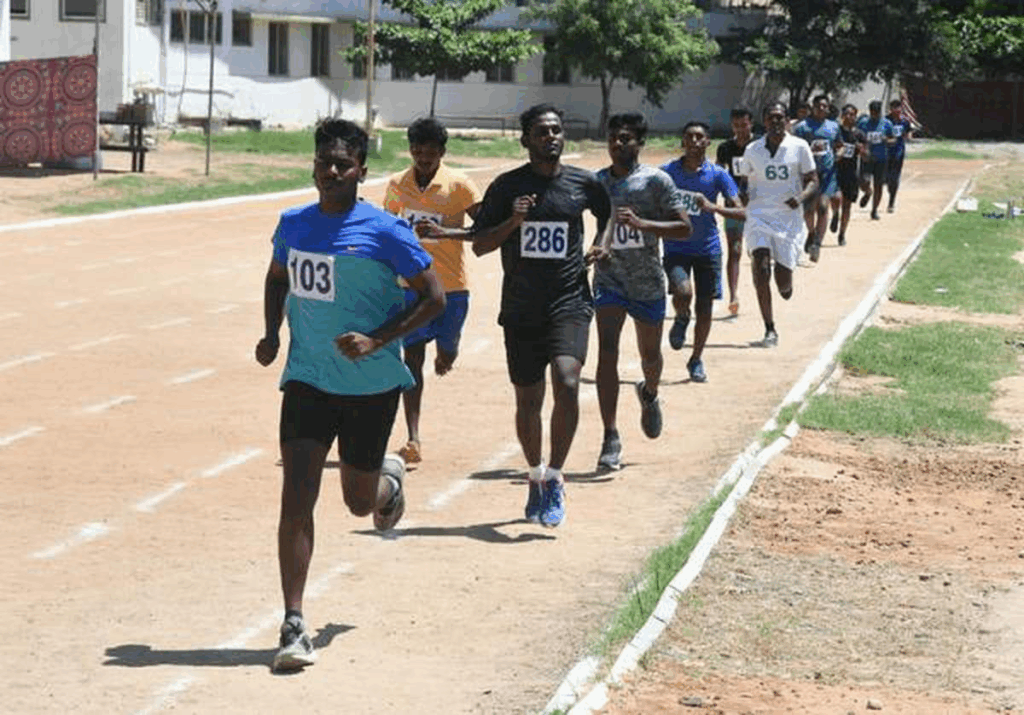
The endurance test includes activities like running, which are time-bound and vary according to age and gender.
For Male Candidates (Age 18–30 years):
| Activity | Criteria |
| 1600 meters run | To be completed in 6 minutes |
| Long Jump | Minimum 14 feet |
| High Jump | Minimum 3’9’’ |
For Female Candidates (Age 18–30 years):
| Activity | Criteria |
| 1600 meters run | To be completed in 8 minutes |
| Long Jump | Minimum 10 feet |
| High Jump | Minimum 3 feet |
(Performance standards may vary for older age brackets.)
Physical Measurement Test (PMT):
Male Candidates:
- Height: Minimum 170 cm (relaxation for reserved categories as per norms)
- Chest: 81 cm (unexpanded) with minimum 4 cm expansion
Female Candidates:
- Height: Minimum 157 cm (relaxation for reserved categories as per norms)
- Chest: Not applicable
Only candidates who qualify the PE&MT move on to the document verification stage.
Stage 3: Document Verification
Shortlisted candidates are required to produce original documents (educational, identity, caste, domicile, etc.) for verification. Failure to provide valid documentation will lead to disqualification.
Stage 4: Medical Examination
Candidates who clear all previous stages undergo a medical fitness test conducted by the concerned authorities of Delhi Police. Vision standards and general health are assessed during this stage.
Final Selection
Final merit is prepared based on the marks obtained in the Computer-Based Examination only. However, candidates must qualify the PE&MT and medical examination to be considered for appointment.
Delhi Police Constable Syllabus 2026 (Detailed)
The Delhi Police Constable 2026 exam is conducted by the Staff Selection Commission (SSC) to recruit eligible candidates for the post of Constable (Executive) in Delhi Police. The exam consists of a Computer-Based Examination (CBE) followed by Physical Endurance and Measurement Tests (PE&MT).
To clear the first stage (CBE), candidates must prepare the following subjects in detail:
1. General Knowledge / Current Affairs
This section is designed to test the candidate’s general awareness about current events and static knowledge.
Topics to Cover:
- Indian History
- Ancient, Medieval, and Modern History
- Important dates and movements
- National leaders and revolutions
- Geography
- Indian and World Geography
- Physical features of India
- Rivers, Mountains, Climate
- Natural resources
- Indian Polity
- Constitution of India
- Fundamental Rights and Duties
- Parliament and State Legislatures
- Judiciary and Executive System
- Panchayati Raj and Local Governance
- Indian Economy
- Basic concepts (GDP, Inflation, etc.)
- Banking and Finance
- Budget and Five-Year Plans
- Economic reforms and policies
- General Science
- Physics: Motion, Force, Light, Electricity
- Chemistry: Matter, Elements, Compounds, Acids & Bases
- Biology: Human Body, Plants, Diseases
- Current Affairs
- National and International Events (past 6–12 months)
- Government Schemes and Policies
- Sports Events and Awards
- Summits and Conferences
- Recent Appointments and Resignations
- Obituaries
- Miscellaneous
- Books and Authors
- Important Days and Themes
- Awards and Honors
- Science and Technology Developments
- Defence and Space News
2. Reasoning Ability
This section evaluates a candidate’s ability to think logically and solve problems using reasoning.
Topics to Cover:
- Analogies
- Letter, number, and image-based analogies
- Letter, number, and image-based analogies
- Coding-Decoding
- Alphabetic and numeric coding
- Substitution and pattern-based coding
- Series
- Number and Alphabet series
- Missing number/letter in a series
- Blood Relations
- Family-based problems
- Paternal and maternal relations
- Direction and Distance
- Distance covered, shortest path, and directions
- Classification
- Odd one out (letters, numbers, figures)
- Syllogism
- Two or three-statement logic-based conclusions
- Statement and Conclusion
- Logical inference questions
- Order and Ranking
- Position-based problems
- Non-Verbal Reasoning
- Mirror and Water Images
- Paper Folding and Cutting
- Embedded Figures and Figure Completion
- Pattern Completion
3. Numerical Ability (Mathematics)
This section tests basic arithmetic and number skills typically studied up to Class 10 level.
Topics to Cover:
- Number System
- Place value, types of numbers, and conversions
- Simplification
- BODMAS rule, decimals, and fractions
- HCF & LCM
- Factorization and divisibility
- Ratio and Proportion
- Comparison of quantities
- Percentage
- Increase/decrease, applications in profit and loss
- Average
- Mean calculation from groups of numbers
- Profit, Loss, and Discount
- Cost price, selling price, and profit margins
- Simple and Compound Interest
- Interest over time, differences between the two
- Time, Speed, and Distance
- Relative speed, trains, boats & streams
- Time and Work
- Efficiency, work completion
- Mensuration
- Perimeter, Area, and Volume of basic 2D and 3D shapes
- Squares, Rectangles, Circles, Cubes, Cylinders, etc.
- Algebra (Basic)
- Simple equations, identities
- Data Interpretation
- Tables, Pie Charts, Line Graphs, and Bar Graphs
4. Computer Fundamentals
This section checks the candidate’s basic understanding of computers and internet usage.
Topics to Cover:
- Basics of Computers
- Characteristics and generations of computers
- Input and Output Devices
- Hardware and Software
- Operating Systems
- Functions and types (Windows, Linux, etc.)
- Basic operations and file management
- MS Office Suite
- MS Word: Text editing, formatting, tables
- MS Excel: Formulas, charts, data handling
- MS PowerPoint: Slides, animations, templates
- Internet and Email
- Web browsers, search engines
- Email structure, attachments, spam
- Networking Basics
- LAN, WAN, IP Address, and protocols
- LAN, WAN, IP Address, and protocols
- Cyber Security
- Viruses, malware, firewall
- Safe browsing practices
- Viruses, malware, firewall
- Digital India and E-Governance
- Basic awareness of digital initiatives by the Government
- Basic awareness of digital initiatives by the Government
- Keyboard Shortcuts and Computer Terminology
Summary
Delhi Police Constable 2026 – Syllabus Summary Chart
| Section | Topics Covered |
| 1. General Knowledge & Current Affairs | – Indian History (Ancient to Modern)- Geography (India & World)- Indian Polity & Constitution- Economy (Basic Concepts)- General Science (Physics, Chemistry, Biology)- Current Events (National & International)- Books & Authors, Sports, Awards- Environment & Ecology |
| 2. Reasoning Ability | – Analogy- Coding-Decoding- Series (Number/Alphabet)- Blood Relations- Direction Sense- Classification/Odd One Out- Syllogism- Statement & Conclusion- Order & Ranking- Non-Verbal (Figures, Images, Embedded Patterns) |
| 3. Numerical Ability | – Number System- Simplification- HCF & LCM- Ratio & Proportion- Percentage- Average- Profit & Loss- SI & CI- Time, Speed & Distance- Time & Work- Mensuration- Algebra (Basic)- Data Interpretation |
| 4. Computer Fundamentals | – Basics of Computer & Hardware- Operating System Functions- MS Office (Word, Excel, PowerPoint)- Internet & Email Basics- Networking Concepts- Cyber Security Awareness- Digital India Initiatives- Keyboard Shortcuts & Terms |
Exam Overview
| Exam Mode | Computer-Based (Online) |
| Total Questions | 100 MCQs |
| Total Marks | 100 |
| Time Duration | 90 Minutes |
| Negative Marking | Yes (0.25 marks deducted for each wrong answer) |
| Exam Language | Bilingual – English & Hindi |
Conclusion:
The Delhi Police Constable Exam 2026 is more than just a test—it’s your gateway to a prestigious, disciplined, and service-oriented career in the nation’s capital. With a clearly defined syllabus covering General Knowledge, Reasoning, Mathematics, and Computer Awareness, the exam is designed to evaluate not only your academic grasp but also your logical thinking and readiness for real-world challenges.
Success in this exam demands more than just hard work—it calls for smart preparation, strategic planning, and unwavering focus. Make use of reliable study materials, stay up to date with current affairs, practice regularly, and maintain physical and mental fitness.
Remember, every constable in uniform began as an aspirant like you—with a goal, a dream, and the determination to make it happen. So stay committed, believe in yourself, and give your best effort every single day.
FAQs
1. Is there any negative marking in the Delhi Police Constable exam?
Ans – Yes, there is a negative marking of 0.25 marks for every incorrect answer. So, candidates should answer carefully.
2. How should I prepare for the Physical Endurance and Measurement Test (PE&MT)?
Ans – To prepare effectively:
- Maintain a daily running routine
- Practice long jump and high jump
- Work on your stamina, flexibility, and body measurements
- Stay hydrated and follow a healthy lifestyle
3. Can I give the Delhi Police Constable exam in Hindi?
Ans – Yes, the exam is bilingual—you can choose either English or Hindi, except for questions related to the English language (if applicable).
4. What is the duration of the Delhi Police Constable written exam?
Ans – The total duration of the Computer-Based Exam is 90 minutes (1 hour 30 minutes) for 100 questions.
5. Is there any minimum qualifying mark in the Delhi Police Constable Exam?
Ans – Yes, SSC sets category-wise qualifying marks. Candidates must meet or exceed these marks to qualify for the PE&MT stage.
6. What documents are required for verification after clearing the written and physical tests?
Ans – You will need to provide:
- Educational certificates
- Caste/Category certificate (if applicable)
- Domicile certificate
- ID proof (Aadhaar, Voter ID, etc.)
- PE&MT admit card and result proofs
7. When will the Delhi Police Constable 2026 exam be conducted?
Ans – The exact exam date will be announced by SSC in its official calendar or notification. It is usually conducted in the last quarter of the year.